
Under DOH-FDA-BOC Joint Circular No. 1 (2015), still cited by the Bureau of Customs in January 2026, a traveller may bring prescription drugs for personal use up to the quantity on a prescription carrying the doctor's licence number. Amounts above the limit are seized. No official source says whether this covers unregistered products. Sources checked 23 September 2026.
Legal
Bringing medicines or peptides into the Philippines
The personal-use import rule for travellers, parcels and balikbayan boxes, the quantity limits, and the questions the official sources leave open.
Video transcript
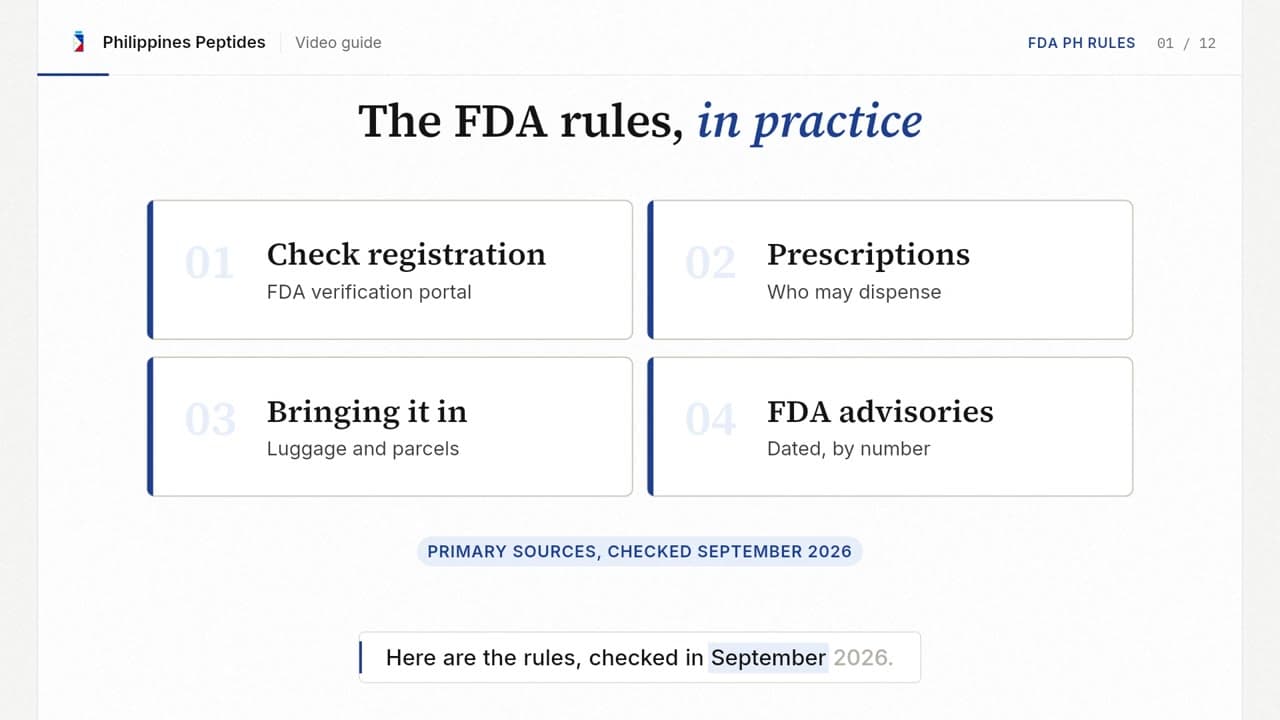
Checking if a medicine is FDA registered, or bringing one into the Philippines? Here are the rules, checked in September 2026. FDA Philippines points you to its verification portal. A registered drug shows a Certificate of Product Registration number and its classification. No certificate means unregistered. Importing or selling an unregistered drug is a prohibited act, and the FDA may seize violative products without a court order. A prescription medicine is dispensed only by a licensed pharmacist, at an FDA-licensed outlet, against a valid prescription, including online orders. Bringing medicines in falls under Joint Circular No. 1 of 2015: passenger baggage, balikbayan boxes and parcels. Prescription drugs: up to the quantity on a prescription with the doctor's PRC licence number. Over-the-counter drugs: 50 grams. Vitamins and supplements: 500 grams in total. Above the limits, without FDA clearance, goods are seized and forfeited, declared or not. Every arriving bag is subject to search. Recent advisories: on 4 September 2026, numbers 2026-1019 and 2026-1020 warned against unregistered tirzepatide vials, and 2026-1013 against a KPV vial. Ozempic, Wegovy, Rybelsus and Mounjaro are registered prescription drugs. Prescribing belongs with a licensed Philippine physician. A research vial is not a registered medicine. Buying from stock already in the Philippines skips customs. Our partner and supplier, Primara Labs, holds stock in Metro Manila. Its vials are for research use only, not approved for human use. Metro Manila orders by noon on a weekday arrive the same day. J&T reaches Luzon in 1 to 2 business days, Visayas 2 to 3, Mindanao 3 to 5. Plus a 60-day money-back guarantee. Read the full rules on Philippines Peptides, then see the catalogue at Primara Labs and order on WhatsApp.
Short answer
The personal-use rule
- DOH-FDA-BOC Joint Circular No. 1, dated 22 June 2015, lets travellers bring listed FDA-regulated products into the Philippines without prior FDA clearance if the products are for personal use and within set limits. (DOH-FDA-BOC Joint Circular No. 1 (2015), 22 June 2015)
- Joint Circular No. 1 applies to products carried in passenger baggage, sent in balikbayan boxes, or sent as parcels by mail or delivery services. (DOH-FDA-BOC Joint Circular No. 1 (2015), 22 June 2015)
- For prescription drugs, Joint Circular No. 1 sets the allowed quantity as the amount stated on a prescription that carries the physician's PRC licence number or a foreign equivalent. (DOH-FDA-BOC Joint Circular No. 1 (2015), 22 June 2015)
- Joint Circular No. 1 sets a limit of 50 grams for over-the-counter drugs and 500 grams in total for vitamins and health supplements taken as maintenance. (DOH-FDA-BOC Joint Circular No. 1 (2015), 22 June 2015)
- Under Joint Circular No. 1, quantities above the limits that lack FDA-DOH clearance are seized and forfeited to the government, whether declared or not. (DOH-FDA-BOC Joint Circular No. 1 (2015), 22 June 2015)
- Joint Circular No. 1 states that dangerous drugs and controlled precursors remain under the rules of the Dangerous Drugs Board and the Philippine Drug Enforcement Agency. (DOH-FDA-BOC Joint Circular No. 1 (2015), 22 June 2015)
- The Bureau of Customs circulated Joint Circular No. 1 to all district collectors by memorandum dated 9 July 2015. (BOC Memorandum (Commissioner Alberto D. Lina), ref. 15-07550, 9 July 2015)
- The Bureau of Customs traveller guide published in January 2026 repeats that the allowable amount of prescription drugs is based on a prescription carrying the doctor's PRC licence number or foreign equivalent. (BOC traveler guide (PDF created 23 January 2026), 23 January 2026)
What Customs says about medicines
- The Bureau of Customs lists pharmaceutical products as regulated imports that require a valid Certificate of Product Registration and/or an FDA License to Operate as importer. (BOC web page (posted 3 April 2023), 3 April 2023)
- The Bureau of Customs lists adulterated or misbranded drugs among prohibited imports under the Customs Modernization and Tariff Act. (BOC web page citing RA 10863 (CMTA) Sec. 118)
- The Bureau of Customs states that all persons and baggage arriving at a Philippine port of entry are subject to search. (BOC web page (posted 3 April 2023), 3 April 2023)
- RA 9711 lists importation among the acts prohibited for health products that require registration but are not registered with the FDA. (RA 9711, 18 August 2009)
What the sources do not answer
- No Philippine FDA, DOH, BOC or DDB document found that addresses products labelled research use only. FDA post searches for 'research use only', 'research purposes', 'laboratory use' and 'not for human consumption' returned nothing. Joint Circular No. 1 does not mention them. The only primary source on the point is Lilly's 12 August 2026 release quoting the US FDA, which is not Philippine law.
- Joint Circular No. 1 does not say whether its prescription-drug allowance covers drugs without a Philippine CPR. No FDA circular that answers this was found.
- No amendment to or replacement for Joint Circular No. 1 (2015) was found. The BOC still cites it on its traveller pages and in its January 2026 guide.
The regulation hub
- Are peptides legal in the Philippines?
- How FDA Philippines registration works, and what "not registered" means
- Prescription rules for GLP-1 medicines
- Is selling peptides legal in the Philippines?
- FDA Philippines advisories on GLP-1s and peptides: timeline
- Regulatory status by compound
Sources checked 23 September 2026. Primary sources only: statutes, DOH and FDA Philippines issuances, the FDA verification portal and the Bureau of Customs. This is general information, not legal advice.